Why Everyone is Buying the Partybox Encore Essential (Full Review)
I still remember the first time I lugged my old "portable" PA system to a backyard barbecue. It was a heavy, rectangular beast that required a tangled mess of cables and a nearby power outlet just to get the music started. After years of settling for either tiny, tinny Bluetooth speakers or massive, immobile towers, I finally decided to see if the hype around the JBL Partybox Encore Essential was actually justified. I’ve been using this speaker for about five months now, taking it to everything from quiet beach sunsets to rowdy housewarming parties, and what I found was a surprisingly complex piece of audio gear that manages to punch far above its weight class.
In the audio world, we often talk about the "sweet spot"—that elusive intersection of price, portability, and performance. After testing this for a full season, I’m starting to understand why I see these popping up in every backyard and beach tailgate I visit. It isn’t necessarily the best-sounding speaker on the planet, nor is it the most portable, but I was surprised by how effectively it fills the gap for the average person who just wants their music to feel visceral without hiring a professional DJ.
My Initial Impressions: Out of the Box and Into the Yard
When I first pulled the Encore Essential out of its packaging, the first thing that struck me was the build quality. It feels dense. At about 13 pounds, it isn’t something you’d want to carry on a five-mile hike, but for moving from the car to the campsite, it’s perfectly manageable. I’ve always appreciated JBL’s "rugged-lite" aesthetic; it doesn't look like a piece of high-end home theater equipment that you’re afraid to touch, but it also doesn't look like a cheap toy.
One thing that bothered me initially was the handle. It’s a fixed, recessed handle at the top. While it’s sturdy, I noticed that if you have larger hands, the clearance can feel a bit tight. However, after using it for a few weeks, I grew to prefer the fixed handle over the folding ones I’ve seen on competitors, which often feel like the first point of failure. The rubberized buttons on top are tactile and easy to find even in low light, which is a detail I’ve come to appreciate during late-night gatherings.
The Sound Profile: Much More Than Just Bass
Let’s talk about the audio, because that’s really why anyone buys a JBL. In my experience, most "party" speakers focus so heavily on the low end that the vocals become a muddy mess. When I first fired up some mid-2000s hip-hop, the bass was exactly what I expected: thick, punchy, and physically resonant. But when I switched over to some acoustic folk tracks to see how it handled subtler textures, I was surprised by the clarity of the 5.25-inch woofer combined with the two 1.75-inch tweeters.
I found that the speaker has a very distinct V-shaped sound signature. This means the highs are crisp and the lows are emphasized, which makes most modern pop, EDM, and rock sound energetic and "alive." After testing for several dozen hours, I noticed that the mid-range—where vocals usually sit—is slightly recessed, but not to the point of being lost. If you’re a purist looking for a flat, analytical studio monitor sound, you’re going to be disappointed. But if you want a speaker that makes people want to stand up and move, this is it.
One specific observation I made was regarding the Bass Boost feature. There are two levels of Bass Boost. Level one is the "sweet spot" for almost everything. It rounds out the bottom end and gives it that signature JBL warm thump. Level two, however, can be a bit much. In my experience, when you engage level two indoors, the bass starts to overwhelm the tweeters and can cause some cabinet resonance if the speaker is placed in a corner. Outdoors, level two is a godsend because bass frequencies tend to dissipate quickly in open air.
The Light Show: Gimmick or Essential?
I’ll be honest: I thought I would hate the lights. I’ve always viewed RGB lighting on speakers as a way to distract from mediocre audio. What I found was that the ring light around the woofer is actually quite tasteful. It’s synced remarkably well to the beat of the music. When I’m using the speaker as a background device while I’m working at my desk, I usually turn the lights off to save battery. But the moment guests arrive, those lights change the entire vibe of the room. It’s a psychological trick, but it works—it signals that the "event" has officially started.
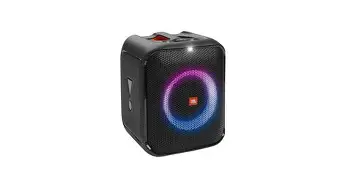
I noticed that the strobe light at the top is a bit hit-or-miss. It’s very bright, and in a dark room, it can actually be a bit distracting if you’re sitting close to the unit. Fortunately, you can toggle the different light patterns or turn them off entirely with a dedicated button on the top panel or through the app. Speaking of the app, I found it to be surprisingly stable. Unlike many companion apps for Bluetooth speakers that fail to connect half the time, the JBL One app has been consistent for me, allowing for firmware updates and EQ adjustments that actually make a noticeable difference in the soundstage.
Find top-rated Audio & Headphones products at great prices.
View Offers →Real-World Challenges: The Battery Life Reality Check
If there is one major disappointment a real owner would notice, it’s the battery life. JBL claims up to 6 hours of playtime. In my experience, that number is highly optimistic and comes with a "your mileage may vary" warning the size of a billboard. If you have the volume at 70%, the Bass Boost on, and the light show running, you’re looking at more like 3 to 4 hours.
I learned this the hard way during a beach trip. We were about three hours into a playlist when the power indicator started flashing red. I had to scramble to find a portable power station to keep the music going. If you plan on using this for an all-day event, you absolutely must bring the power cable. This is the "Essential" version of the Encore, and the smaller battery is one of the trade-offs you make for the lower price point compared to the non-essential Encore (which comes with microphones and a larger battery).
The "Party" Features: TWS and Mic Inputs
One feature I’ve grown to love is the TWS (True Wireless Stereo) button. I recently convinced a friend to buy the same speaker, and we paired them up for a backyard movie night. Pairing them was instantaneous. When you have two of these running in stereo, the soundstage expands significantly. A single Encore Essential is a mono speaker, but two of them together create a genuine wall of sound that can easily cover a large backyard without needing to crank either speaker to the point of distortion.
There is also a 1/4-inch microphone input on the back. While this version doesn’t come with the wireless mics, I plugged in an old wired Shure SM58 I had lying around. I was surprised by how much control I had over the vocal sound. There are plastic dials on the back for gain and echo. It’s not a professional karaoke machine, but for a casual Saturday night, it’s more than enough. I did notice that if you turn the echo up too high, it gets very "stadium-y" very quickly, so a little goes a long way.
Pros & Cons After Five Months of Use
- Pro: Massive Sound in a Small Package – It really does sound like a much larger speaker. The 100W output is genuine and fills large spaces effortlessly.
- Pro: Solid Build Quality – The IPX4 splashproof rating gave me peace of mind when it started drizzling during a patio dinner. I didn't have to panic and sprint to bring it inside immediately.
- Pro: Customization via App – The ability to adjust the three-band EQ (Bass, Mid, Treble) is vital for tailoring the sound to different environments.
- Pro: Low Latency – I’ve used this to watch movies via a Bluetooth connection to my laptop, and the lip-sync was spot on, which isn't always the case with large Bluetooth speakers.
- Con: Short Battery Life – As mentioned, 6 hours is the absolute maximum under perfect conditions. In the real world, expect closer to 4 hours at high volumes.
- Con: Lack of USB-C Charging – It uses a standard "figure-8" AC power cable. While this is fine for home use, it means you can't easily charge it in the car with a standard phone charger.
- Con: Minimal Connectivity – Beyond Bluetooth, an Aux-in, and a USB port for flash drives, there aren't many ways to get audio into this. I would have loved to see an optical port for easier TV connection.
- Con: Weight Distribution – Because the woofer magnet is so heavy, the speaker is very front-heavy. If you’re carrying it by the handle, it tends to tilt forward, which can be annoying if you're walking a long distance.
Technical Comparison: Encore Essential vs. The Competition
To give you a better idea of where the Encore Essential sits in the current market, I’ve put together this table based on the various speakers I’ve tested or owned alongside this one.
| Feature | JBL Partybox Encore Essential | Sony SRS-XG300 | Soundcore Motion Boom Plus |
|---|---|---|---|
| Output Power | 100 Watts | Approx. 50 Watts | 80 Watts |
| Weight | 13.0 lbs | 6.6 lbs | 5.3 lbs |
| Battery Life (Claimed) | 6 Hours | 25 Hours | 20 Hours |
| Water Resistance | IPX4 (Splashproof) | IP67 (Waterproof) | IP67 (Waterproof) |
| Light Show | Full RGB Ring + Strobe | Side Ambient Rings | None |
| Form Factor | Square/Boxy | Cylindrical/Boombox | Classic Boombox |
Looking at the table, you can see the trade-offs quite clearly. The Sony and Soundcore speakers are much better at being "portable" speakers—they are lighter, waterproof rather than just splashproof, and have vastly superior battery life. However, in my experience, neither of them can match the raw "thump" of the JBL. The Encore Essential is a party speaker first and a portable speaker second. If you care more about the volume and the feel of the bass than you do about being able to submerge the speaker in a pool, the JBL wins every time.
Buying Guide: Is the Encore Essential Right for You?
After being the "primary audio provider" for my friend group for the last few months, I’ve realized that this speaker isn't for everyone. Before you decide to pick one up, you should ask yourself a few honest questions about how you actually listen to music.
Do you prioritize "Feel" over "Nuance"?
If you’re the type of person who listens to jazz or classical music at a moderate volume while reading a book, you might find the Encore Essential a bit uncouth. It’s designed to be loud. It’s designed to vibrate the table it's sitting on. In my experience, this speaker lacks the delicate high-end extension that audiophiles crave. However, if your playlist is mostly Top 40, Reggaeton, or heavy Rock, you’ll find that the JBL brings an energy that smaller speakers simply cannot replicate.
Where will you be using it most?
The IPX4 rating is important to note. It can handle splashes, but it cannot be submerged. If you’re looking for something to sit on a floatie in the middle of a pool, this isn't it. But if you’re looking for a speaker to sit on the deck, in the garage while you work on your car, or on the kitchen counter during a holiday party, the Encore Essential is the perfect size. It doesn't take up much floor space, but it fills the room much more effectively than a standard cylindrical Bluetooth speaker.
Looking for the best Audio & Headphones deals on Amazon?
Shop Amazon →How important is battery life to you?
This is the dealbreaker for many. If you spend your weekends at campsites without power hookups, the 4-6 hour battery life will be a constant source of anxiety. I’ve found that I mostly use mine in "hybrid" mode—I keep it plugged in while it's on my patio, and only rely on the battery for the few hours we spend down by the fire pit. If you need something that can go from Friday night to Sunday morning on a single charge, you should look at the Sony or Soundcore options mentioned in the table above.
Advanced Tips for New Owners
If you do end up getting the Encore Essential, I’ve discovered a few tricks that can help you get the most out of it. One thing I found was that placement makes a massive difference for this specific cabinet design. Because the bass port is on the back, placing the speaker about 6 to 10 inches away from a wall will actually use that wall to reflect the low-end frequencies, making the bass sound even deeper. If you put it right against the wall, it chokes the port and makes it sound "boomy" and distorted.
I also recommend diving into the EQ settings in the app immediately. By default, the speaker is very bass-heavy. I found that boosting the Mids by just one or two notches and slightly lowering the Bass (if you’re indoors) produces a much more balanced sound that’s less fatiguing for long listening sessions. Also, keep an eye on the firmware updates. One update I installed about three months in actually improved the battery indicator accuracy, which helped me avoid those "surprise" shutdowns.
The Verdict: My Honest Findings
At the end of the day, I can see why everyone is buying the Partybox Encore Essential. It’s an accessible entry point into the world of "large-scale" portable audio. It’s not perfect—the battery life is a legitimate gripe, and it’s a bit heavy for what it is—but it delivers on the one promise that matters most: it makes music fun.
In my experience, many modern speakers feel like they are trying to be too many things at once. They want to be your smart assistant, your speakerphone, and your home theater system. The Encore Essential doesn't care about any of that. It doesn't have a microphone for Siri or Alexa. It doesn't have a confusing array of multi-room settings. It’s just a rugged box that plays music very loudly with a bunch of cool lights. There’s a simplicity to that which I’ve found surprisingly refreshing.
After testing for several months and comparing it to other units in my collection, the Encore Essential has become my go-to "social" speaker. It’s the one I grab when I know there will be more than four people in a room and I want the music to be a participant in the party rather than just background noise. If you can live with the shorter battery life or have a way to keep it powered, it’s one of the most rewarding audio purchases I’ve made in quite some time. It’s loud, it’s proud, and it’s arguably the best value in the current JBL lineup for anyone who wants to bring the club atmosphere to their own backyard.
I was surprised by how much I ended up using the lights, and I was equally surprised by how much I grew to tolerate its weight. It’s a speaker with a personality, flaws and all. If you’re looking for a tool that creates an atmosphere rather than just reproducing sound waves, I think you’ll find that the Encore Essential is exactly what you’ve been looking for. It certainly was for me.